Audience & Position
Who the company or offer serves, the problem, the competitive alternatives, where it stands against them.
Company + each offerThe operating system
RAOS is Revenue Architecture in action: the operating system a company runs its revenue on, across people, process, rhythm and technology. It sits above the tools you already use.
How it runs
Five parts: Continuum · Model · Calibration · Connections · RAI.
Where each offer sits.
Each offer is placed by what carries the value the buyer pays for, and who is accountable for it: Expertise, Service, Automated Service, Product or Network. It applies offer by offer, never to the company, and it isn’t a ranking.
The five positions →What revenue runs on.
Twenty-three components across Strategy, Platform and Production, built in six units. Each offer depends on 14 of them, fit to its Continuum position.
See the Model →How it stays fit.
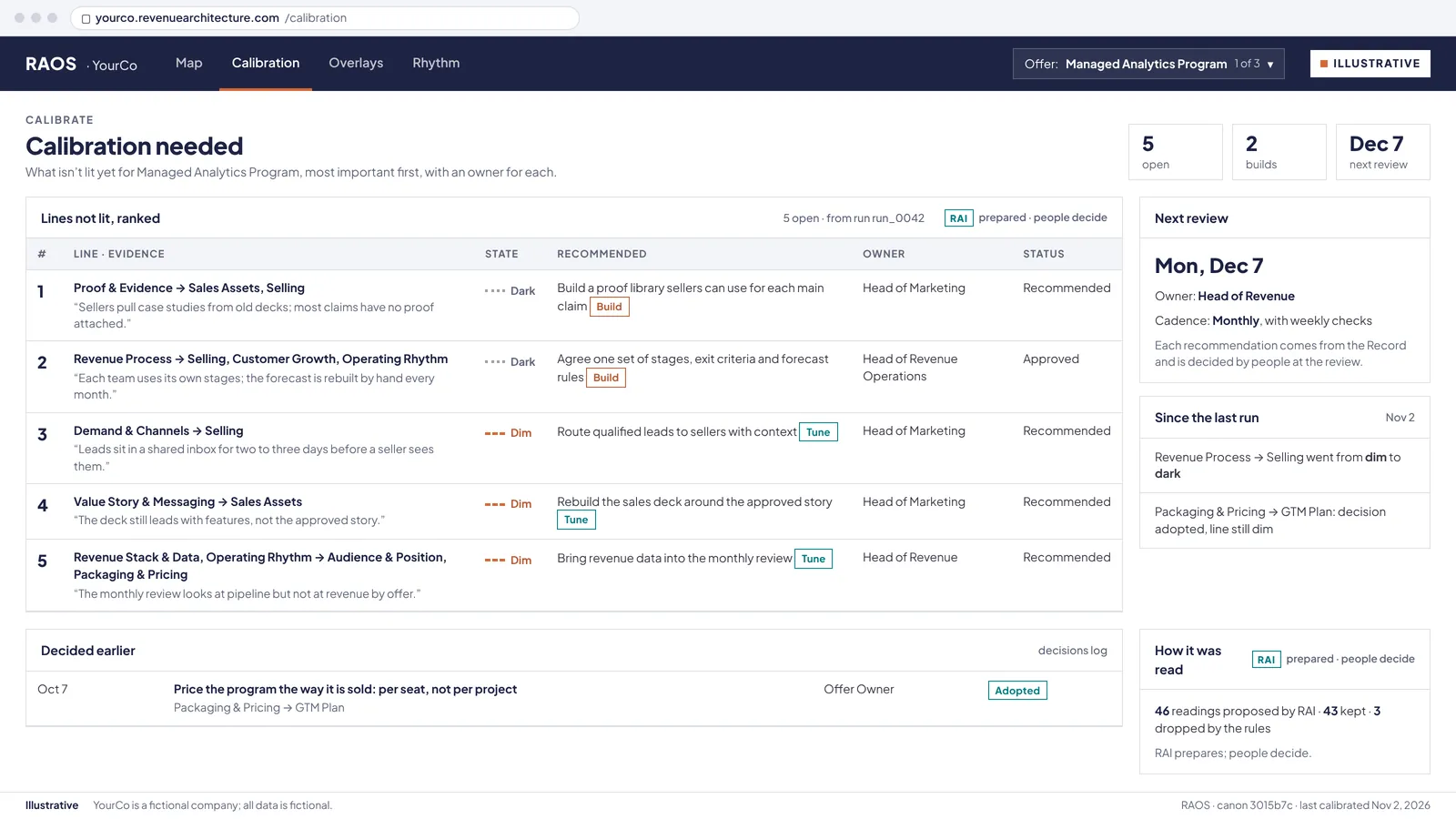
The loop around the Model. It reads each offer’s components, Connections and Continuum position against the evidence, and every review ends in a call: shift, tune or no change needed.
How Calibration works →Where components hand off.
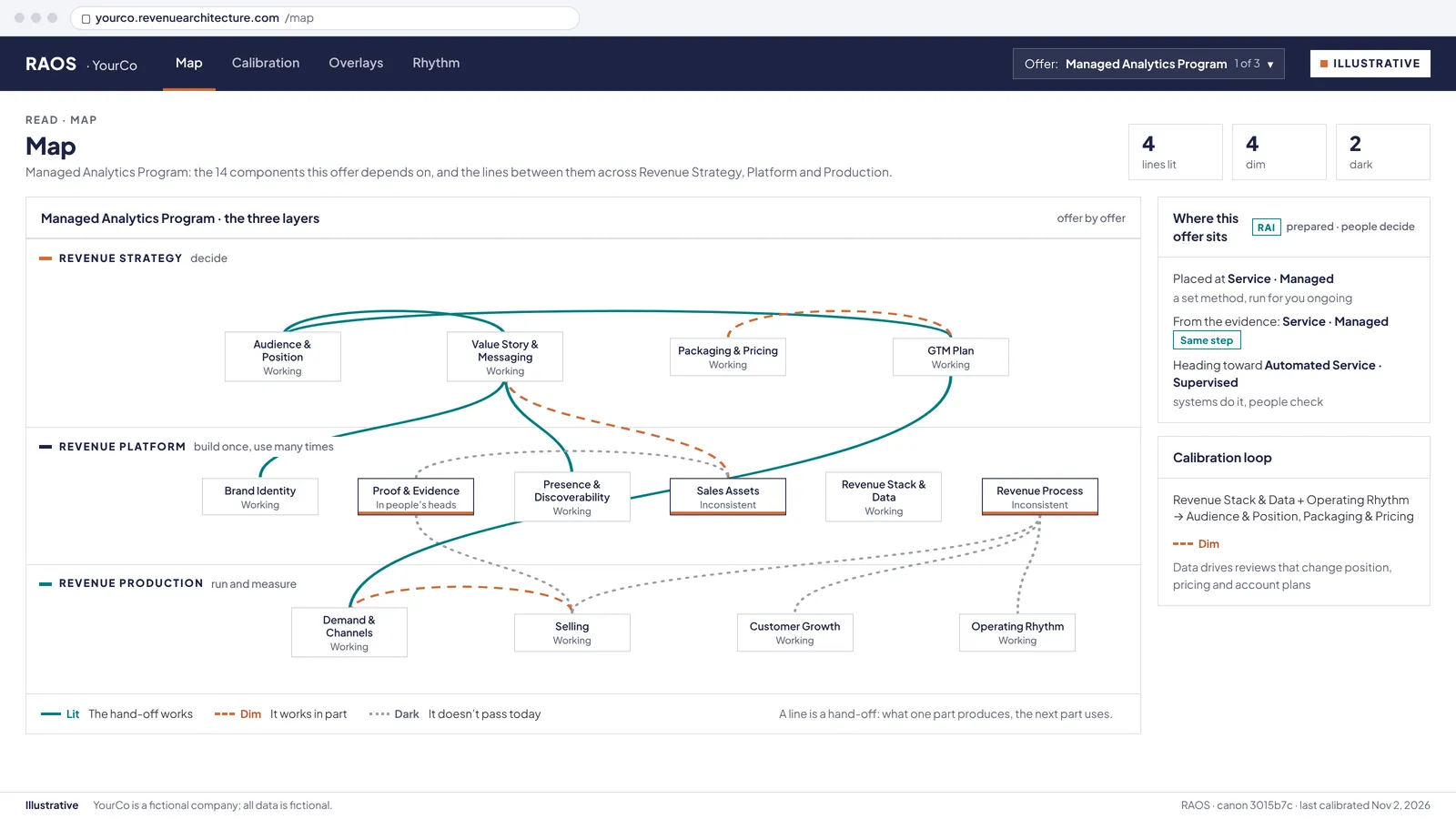
The named hand-offs between components, shown lit, dim or dark for each offer: the value story reaching the sales assets, delivery outcomes becoming proof. Dim and dark Connections are what Calibration acts on.
See the Connections →Revenue Architecture Intelligence, the intelligence layer.
RAI holds the Record, keeps the system current between reviews and carries the state of the Connections. RAI prepares; people decide.
RAI at work →Human-orchestrated. AI-enabled.
Part 1 · Continuum
The Continuum places each offer by what carries the value the buyer pays for, and who is accountable for it. It applies to each offer, never to the company. A company usually has offers at more than one position, and each one needs its own fit. It is not a ranking or a maturity path: an offer can move in either direction.
The Continuum, with example offers. The Continuum places each offer by what carries the value the buyer pays for, and who is accountable for it. Ordered by who does the core work the buyer pays for · not a ranking. Expertise: Judgment of named, accountable people, working with agents; the buyer pays for the person’s call (Advisory, Consulting). Service: A team’s method, scope set before the sale; the firm is accountable (Project, Managed). Automated Service: The provider’s systems and agents; the provider is accountable at machine volume; people supervise (Supervised, Systems-run). Product: An asset the buyer uses (physical, software, data); the buyer is accountable for its use (Complex, Scalable). Network: Participants the provider connects; the provider is accountable for the rules. The line between people and systems sits between Service and Automated Service. Three example offers from one company. Each starts at its position on the Continuum. Offer A · an implementation project, at Service; Offer B · a managed service, at Service, heading right toward Automated Service (shift right · more systems); Offer C · a software product, at Product, heading left toward Automated Service (shift left · more people).
The people | system boundary sits between Service and Automated Service. Ordered by who does the core work the buyer pays for · not a ranking.
An Expertise offer sells the judgment of named people, so its proof, sales assets and selling process are built around them. An Automated Service offer sells what the provider’s systems deliver at volume, so the same components are built around the system, with people supervising. Offers that sit close together share what’s built once; offers far apart each get their own.
Shift right is toward Network: more of the value moves into systems. Shift left is toward Expertise: more of it moves back to people. AI is moving many offers across the line between people and systems. When an offer moves, the components it depends on have to be refit.
Part 2 · Model
The Model holds the 23 components every company’s revenue runs on. They are built in six units: the components that are developed and changed together. Each offer sits at the centre, and its position on the Continuum sets what each unit must contain for it.
Example offer
Offer A · implementation project
Its position on the Continuum sets what each unit must contain for it.
For diagnosis, the same 23 components are read by layer (Strategy, Platform, Production) and domain. Each offer depends on 14 of them. Move an example offer along the Continuum to see how its scope changes, or open a component to see what it holds.
The Continuum: what carries the value the buyer pays for
Three example offers from one company. Each starts at its position on the Continuum. Offer A · an implementation project, at Service; Offer B · a managed service, at Service; Offer C · a software product, at Product. Offer B is heading right toward Automated Service (shift right · more systems). Offer C is heading left toward Automated Service (shift left · more people).
decide
Who the company or offer serves, the problem, the competitive alternatives, where it stands against them.
Company + each offerThe argument for choosing this company and offer; cascades company → offer → audience → engagement.
Company + each offerWhat the buyer gets and on what terms: each offer’s packaging, revenue model and price, under a company-wide portfolio and price architecture.
Company + each offerHow each offer reaches new buyers: routes to market, channels and partners, agent channels, selling model, targets, coverage.
Shared by positionbuild once, use many times
Name, mark, voice, visual system.
Company-wideThe verified base for every claim: cases, results, references, credentials, each with its source.
SharedOwned digital surfaces, search and AI-assistant presence, listings, structured offer data.
Company-wideAssets used to persuade: decks, proposal templates, playbooks, case summaries.
SharedCommercial systems and data: CRM, marketing and sales systems, interfaces to quoting and billing, customer data.
Company-wideThe defined way revenue runs: lifecycle stages and exit criteria, qualification standard, hand-offs, forecast method, metric definitions.
Company-widerun and measure
Recurring demand work: campaigns, content, events, thought leadership, PR, partner co-marketing.
Per offerPursuits from first conversation to agreement, and the coaching and deal support that equip sellers.
Shared by positionAccount management, renewals, expansion and cross-sell, advocacy.
Company-wideRecurring management work across all components and offers: pipeline and forecast reviews, offer reviews, calibration reviews, win/loss, market sensing, planning.
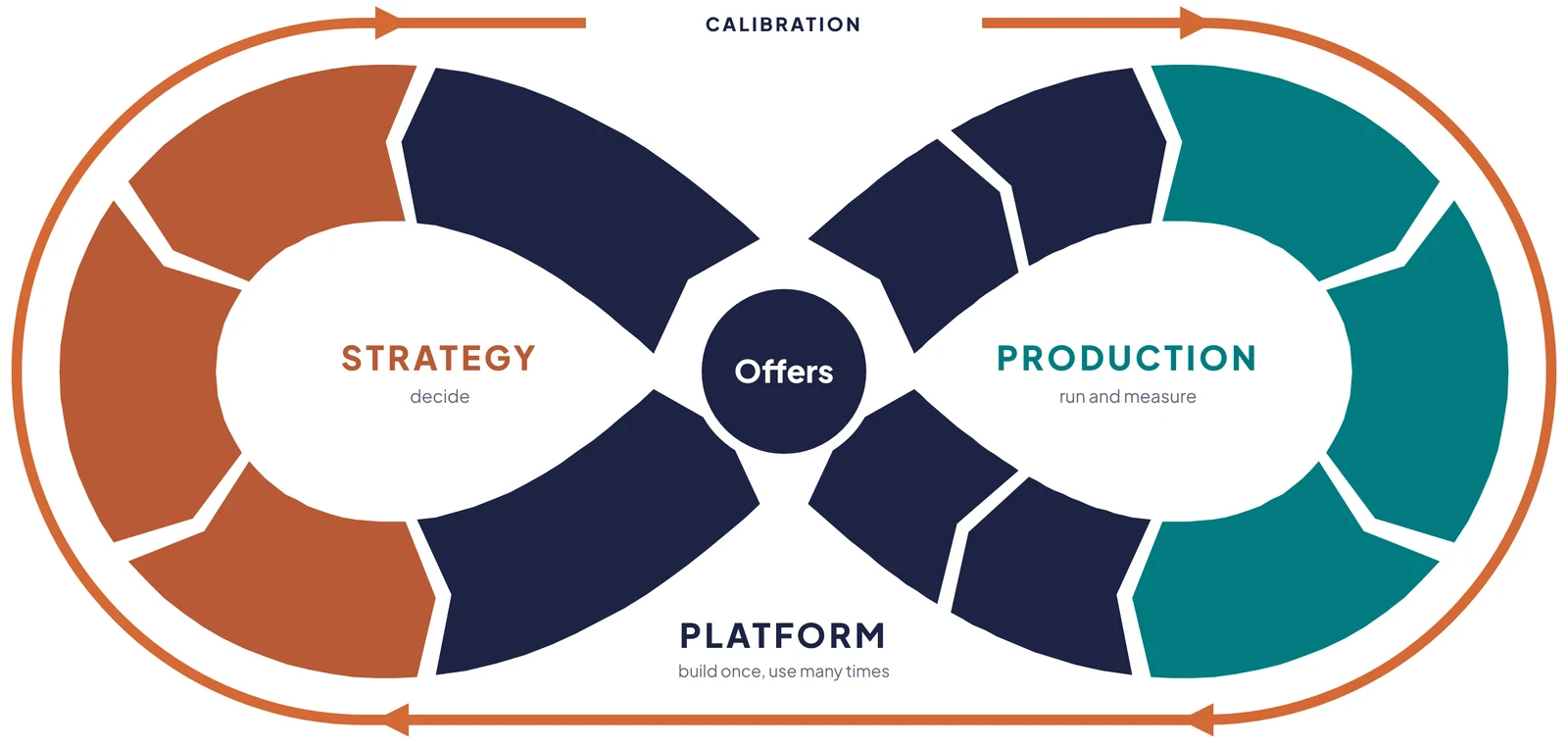
Company-wideCalibration
Calibration tests each offer’s architecture against where it sits on the Continuum and against the evidence, and ends in a decision: shift · tune · no change needed.
1 · Something changes
An offer moves along the Continuum, or the market moves around it.
2 · The review
Inside the Operating Rhythm, the offer’s components and Connections are tested against where it sits and against the evidence.
3 · The call
People make it: shift · tune · no change needed.
The explorer calls this move a shift because the position changed. It never judges a real company; in Calibration, people make the call.
Nearby offers share. Distant offers each get their own.
23 components in three layers and six domains. Each is one object: what it holds and its default scope. ★ marks the 14 an offer depends on.
Build unit · Value to Market
Who the company or offer serves, the problem, the competitive alternatives, where it stands against them.
Company + each offerBuild unit · Value to Market
The argument for choosing this company and offer; cascades company → offer → audience → engagement.
Company + each offerBuild unit · Value to Market
What the buyer gets and on what terms: each offer’s packaging, revenue model and price, under a company-wide portfolio and price architecture.
Company + each offerBuild unit · Value to Market
How each offer is fulfilled: the human, AI and technology mix, capacity, cost to serve, quality standard, outcome commitments.
Per offerBuild unit · Route to Revenue
How each offer reaches new buyers: routes to market, channels and partners, agent channels, selling model, targets, coverage.
Shared by positionBuild unit · Deliver & Grow
Which accounts to keep and grow, renewal and expansion paths across offers, referral and advocacy approach.
Company-wideBuild unit · Operating Core
How revenue work is organized and governed: offer ownership, roles, decision rights, which metrics count, controls, and who decides what is company-wide, shared or per offer.
Company-wideBuild unit · Market Presence
Name, mark, voice, visual system.
Company-wideBuild unit · Market Presence
The verified base for every claim: cases, results, references, credentials, each with its source.
SharedBuild unit · Commercial Backbone
The authoritative offer definitions: packages, price books, contract and SOW templates, commercial terms, readable by people and machines.
Company-wideBuild unit · Market Presence
Owned digital surfaces, search and AI-assistant presence, listings, structured offer data.
Company-wideBuild unit · Market Presence
Assets used to persuade: decks, proposal templates, playbooks, case summaries.
SharedBuild unit · Deliver & Grow
Methods, IP, templates, tools and agents used to deliver.
SharedBuild unit · Deliver & Grow
Standing programs for existing accounts: onboarding, reviews, success plans, community.
Company-wideBuild unit · Commercial Backbone
Commercial systems and data: CRM, marketing and sales systems, interfaces to quoting and billing, customer data.
Company-wideBuild unit · Operating Core
The people and agents who do revenue work: roles, skills, capacity, incentives.
SharedBuild unit · Route to Revenue
The defined way revenue runs: lifecycle stages and exit criteria, qualification standard, hand-offs, forecast method, metric definitions.
Company-wideBuild unit · Commercial Backbone
Quoting, approval, contracting, billing, collection, revenue leakage.
Company-wideBuild unit · Route to Revenue
Recurring demand work: campaigns, content, events, thought leadership, PR, partner co-marketing.
Per offerBuild unit · Route to Revenue
Pursuits from first conversation to agreement, and the coaching and deal support that equip sellers.
Shared by positionBuild unit · Deliver & Grow
The delivery work, and measurement of outcomes realized against what was sold.
Per offerBuild unit · Deliver & Grow
Account management, renewals, expansion and cross-sell, advocacy.
Company-wideBuild unit · Operating Core
Recurring management work across all components and offers: pipeline and forecast reviews, offer reviews, calibration reviews, win/loss, market sensing, planning.
Company-widePart 3 · Calibration
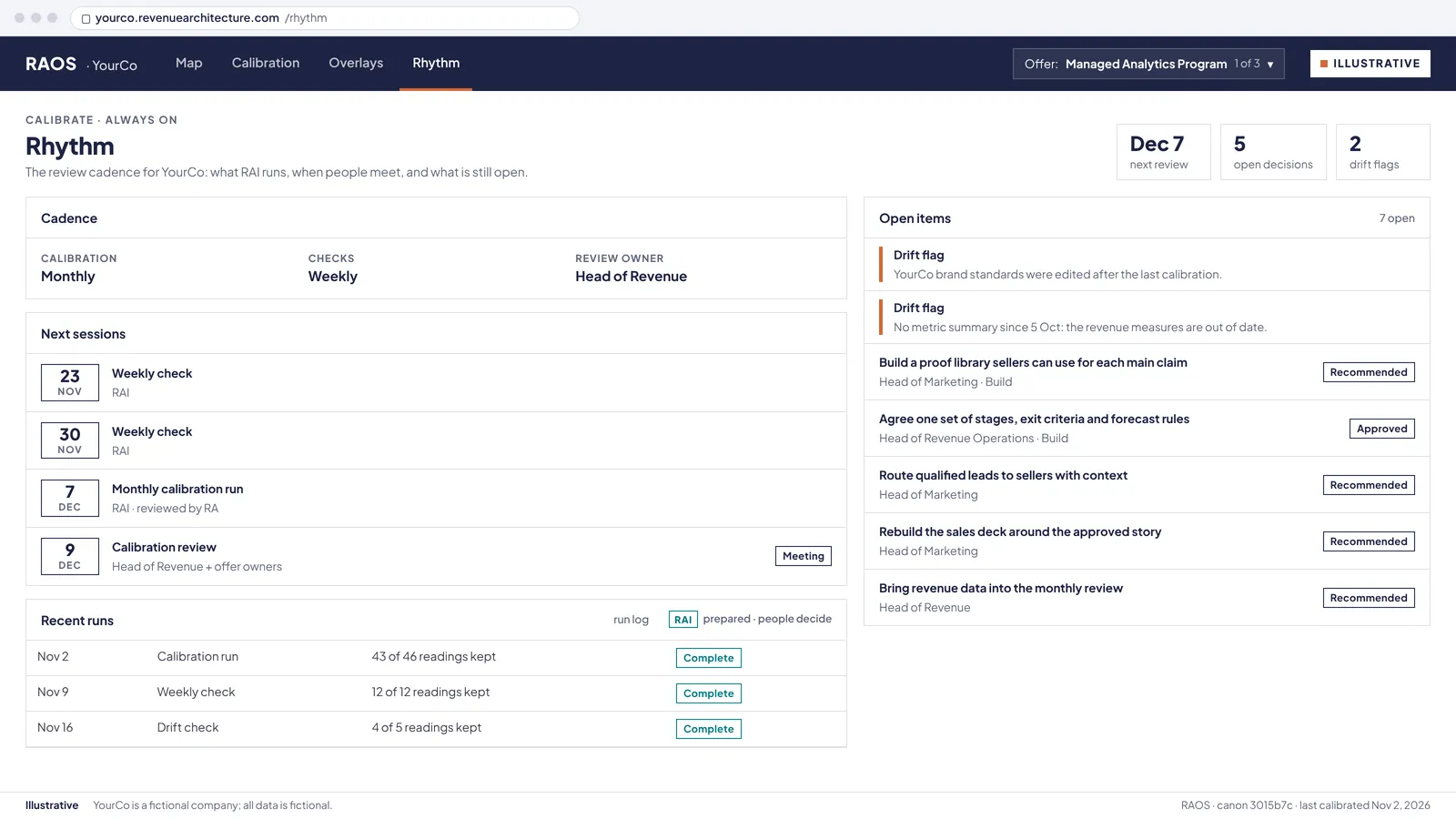
Calibration tests each offer’s architecture against where it sits on the Continuum and against the evidence, and ends in a decision: shift · tune · no change needed. It reads each offer on two bases: its components and the Connections between them, and its Continuum position. Strategy changes reach it through the components they touch. It is part of the Operating Rhythm: reviews on a set cadence, quarterly as the standard and monthly while an offer is shifting. Each review asks what changed, what drifted, and what to do about it.
Between reviews, a live question is answered as a Calibration note, logged in the Record; when it needs a component built or changed, that build is scoped in its unit. Calibration can start from any of four ways in: the Diagnostic, a live question, a conversation, or the Facilitated Diagnostic.
Part 4 · Connections
Connections are the named hand-offs between components: what one component passes to another so the second can do its job. Each is lit, dim or dark for an offer: lit when it holds and the component downstream uses what the one upstream decided, dim when it holds in part, dark when it doesn’t. RAOS shows the state of the Connections offer by offer, and which offers each gap affects; Calibration acts on the dim and dark ones.
Part 5 · RAI
RAI is the intelligence layer of RAOS. It holds the Record and keeps the system current, offer by offer: the state of the Connections, which business context is up to date, and what needs calibrating before each review. People make the calls.
Today RAI is practitioner-run: our team operates a combination of tools, AI and your Record, and the technical roadmap builds more of it out over time.
RAI is part of the architecture, not a product. A reader of the book can build the layer with the AI their company already uses.
RAI does the groundwork; people lead.
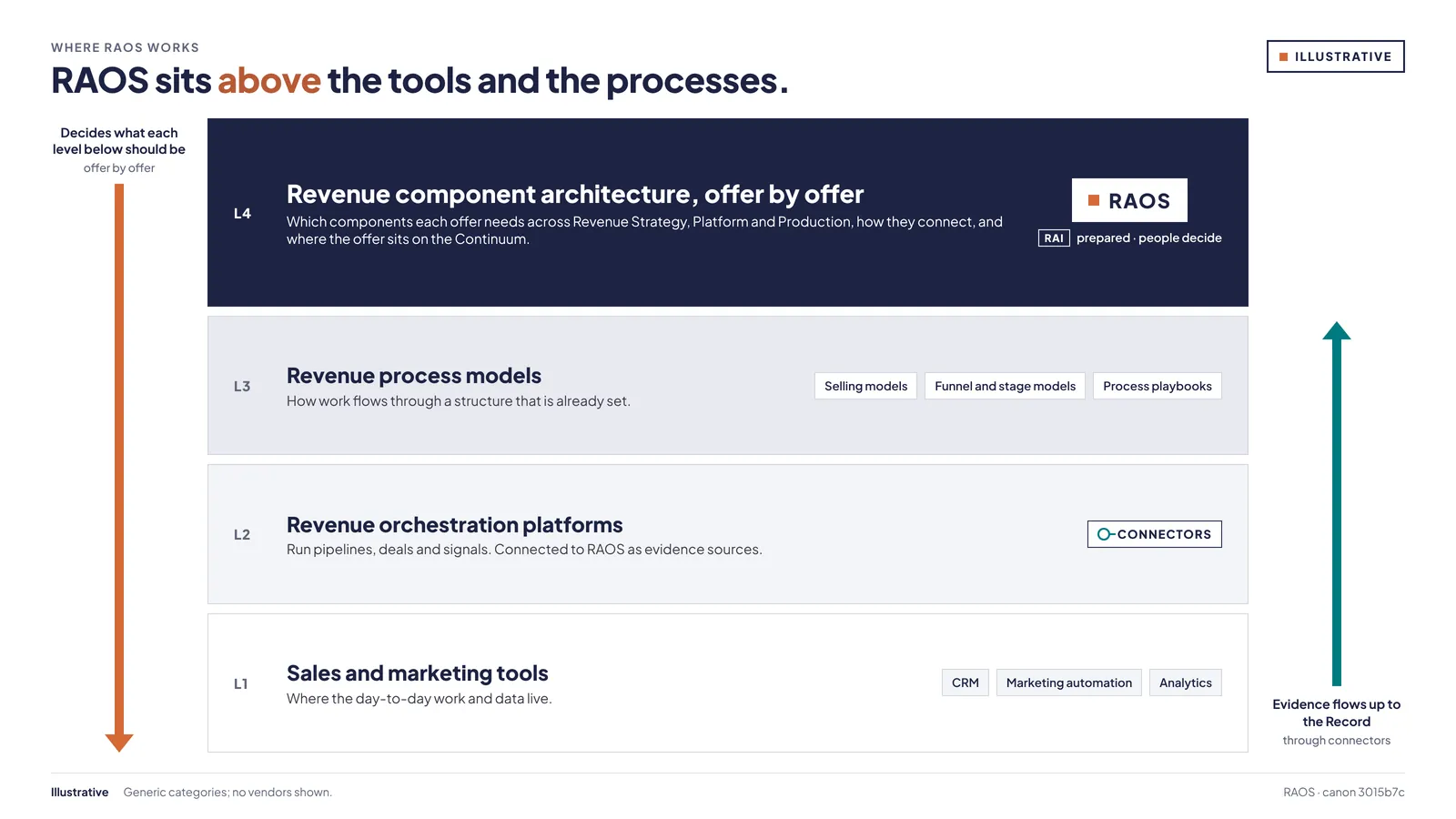
The vision
As agents take on more of your revenue work, RAOS is where you decide what each motion should be, offer by offer. Offers will be sold by people, by agents, or both. Someone still has to decide what they sell, to whom, at what price, and whether the hand-offs hold.
Each component of the Model has a method, in three sections: